• Menu
  • Skip to primary navigation
  • Skip to secondary navigation
  • Skip to main content
  • Skip to footer

Straton Electrical

Electricians in Gqeberha (Port Elizabeth)

  • Home
  • About
    • Automation
    • Electrical
    • Energy Performance Certificates
    • Plumbing
    • Projects
    • Prepaid
    • Reach
    • Solar
    • Straton Water Monitor
  • Tips
  • News
  • Contact
  • Shop
  • Newsletter
  • Loyalty
    • Free Loyalty App
  • FAQ’s
  • BA Systems
  • Mbane
  • Reach Trust
  • Stratlec Shop
  • Straton Electrical
  • Straton Prepaid
  • Straton Solar
  • Home
  • About
    • Automation
    • Electrical
    • Energy Performance Certificates
    • Plumbing
    • Projects
    • Prepaid
    • Reach
    • Solar
    • Straton Water Monitor
  • Tips
  • News
  • Contact
  • Shop
  • Newsletter
  • Loyalty
    • Free Loyalty App
  • FAQ’s

Alan

Electricity Saving Tip – Refrigerator

15 February 2021 By //  by Alan

The most energy efficient refrigerator style is a top-mount freezer refrigerator.

The variation in how much energy savings can be achieved with a top-mount freezer refrigerator depends in part, ENERGY STAR® states, on whether it has an ice dispenser. Generally a top-mount freezer refrigerator that has earned ENERGY STAR® certification uses less energy than a 60-watt light bulb.

  • Choose a refrigerator of a size based on the needs of your family – a refrigerator operates at peak efficiency when filled.
  • Do not overload your fridge, excessive products in your fridge will lower the quality of the food and use more electricity – as much as 10-20% more for each extra product.
  • Do not set freezing temperatures lower than necessary, it wastes as much electricity as excessive heat.
  • Thick frost on chilling panels reduces cooling ability. If you do no t have a frost-free model, defrost your refrigerator when frost is between 0,6 to 1,3 cm thick.
  • Do not open your refrigerator door needlessly. By getting into the habit of removing and replacing several articles at once, you will reduce the loss of cold air.
  • Let hot foods cool down before placing them in the refrigerator. (To prevent bacterial growth allow about 20 minutes standing time).
  • Be sure the seal around your refrigerator door is intact. (Close the door on a piece of paper: if you can pull the paper out easily, the seal should be replaced).
  • Remove all heavy wrapping from food before storing it in the refrigerator.
  • Cover all liquids stored in the refrigerator (especially frost-free models).
  • Foods should be placed slightly apart on refrigerator shelves to allow the cooling air to circulate.
  • Exposed condenser coils/panels (usually at the back of the unit) MUST be kept clean and dust free. When cleaning you must be careful not to damage the panels.
  • Do not place the refrigerator near the stove or against an uninsulated wall that faces the sun.
  • Allow adequate space around the refrigerator for free air circulation. The air carries heat away from the fridge – if air can not circulate, the fridge can not work properly.
  • Switch on the energy saving switch, if one is fitted to the refrigerator.
  • Switch off, empty or clean your fridge, when taking an extended holiday.

Go further and save more with: Building Automation Systems / Solar PV Installations / Metering Solutions.

Defy 157Lt Solar Hybrid Fridge/Freezer

One solution that we particularly like is the newly released Defy Solar Fridge option. Obviously we would prefer that you install Solar PV to power your entire home but the price point of the Defy option is quite compelling for those on a budget:

The Defy Solar Hybrid Range offers an estimated 40% Reduced Energy Consumption

With rising energy tariff increases in South Africa, the cost of energy is almost 4 times higher than inflation and has made a significant impact on all South African pockets. Solar options have been available, however, are only accessible to a select few given the high costs.

Defy has found a way to change this, with a solution that sets a new benchmark in energy consumption, all the while maintaining continuity in functionality. Defy’s All New Solar Hybrid Range uses one simple solar panel that will power the entire fridge or freezer for up to 36 hours with no batteries or converters. The idea behind this innovation is to power homes with the most affordable, versatile and renewable technology that exists today.

During the day the unit will run completely off the sun’s energy and as the sun sets, the internal mechanism will switch back to the electrical grid allowing the unit to run efficiently. Having daytime stable energy, powered by the sun, will reduce energy consumption and the carbon footprint of coal supplied electricity. With Defy’s Hybrid solution, affordable energy has never been this accessible.

The process of purchasing one of these Solar Hybrid units begins with the customer calling Defy’s customer service line. The shopper will be directed to the nearest Defy store and a team of installers will be dispatched to the customer’s home, where they will assess the potential placement for the solar panels in relation to the fridge-freezer unit.

The entire process, from contacting the customer service line to purchasing the Solar Hybrid unit, to having it installed, is expected to be completed within three days.

“The total cost is less than R6,000,” says Defy Marketing Manager, Cagdas Fidan. “Although the prices may vary from one dealer to another it will still be less than R6,000 and the solar panels are included in that price.”

While the retail price includes both the desired Solar Hybrid unit and the accompanying solar panel, customers will still need to pay for the installer’s “consumables”. Fidan explains that this additional cost for brackets and cables will be kept to a minimum. The unit, panel and installation will also come with a warranty.

While Defy’s Solar Hybrid range is more expensive than other fridges and freezers of the same capacity, Albas explains that saving on an electricity bill would eventually see the unit paying for itself.
Filed Under: Tips

Electricity Saving Tip – Dishwasher

15 February 2021 By //  by Alan

Appliances that heat water are the highest consumers of electricity in the home:

There has long been a debate over what method of dish washing has the lowest environmental impact: hand washing or using a dishwasher. The consensus is that dishwashers are the better choice because they most efficiently use water, using an average of 22 litres of water – or only 7.5 to 15 litres for Energy Star efficient models – per full load, whereas hand washing consumes 7.5 litres of water for every minute the tap is running and far more soap.

  • Dishwasher energy consumption can be reduced by turning off the dishwasher after the final rinse and before the drying cycle. The clean dishes can then be wiped with a dry cloth.
  • Fill the dishwasher completely before operating. Partial loads waste electricity and water.
  • Short wash cycles, rinse-only cycles, mid-cycle turn-off, and other features are designed for energy conservation as well as convenience.
  • Connect your dishwasher to COLD water supply unless otherwise directed. Normally only one wash and one final rinse cycle requires hot water which is heated by an element in the dishwasher.
  • The dishwasher filters must be kept clear of debris. A blocked filter reduces efficiency and wastes energy.
  • Proper loading is important for the dishwasher to work efficiently.
  • Use a dishwasher that has an “AIR DRY” option.
  • Try to find a unit that has a high temperature setting that can be disabled with a switch.

Go further and save more with: Building Automation Systems / Solar PV Installations / Metering Solutions.

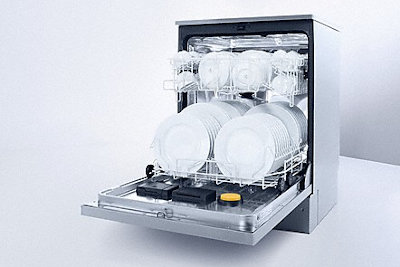
Miele Dishwasher
Miele Dishwasher

Dishwashers use less water (and less hot water) than using a sink.

The key is buying a dishwasher that is not an energy pig and realizing you will only be able use during the “good times”. The good times are those times when the batteries are full and the sun is still shining or the wind is still blowing. Using your dishwasher when the batteries are low means more generator time and more fuel consumed.

A decent dishwasher will use less than 1kWh per load. If you turn off the water heating element and electric drying element, a dishwasher will consume closer to 500 watt hours per load, not including the energy required to pump and heat the water.

The ENERGY STAR Most Efficient list for 2021 lists the Miele G 6935 SCi dishwasher as the most energy efficient dishwasher with a projected Annual Energy Use (kWh/yr) of 199 kW and with a projected 11.25 litres of water use per cycle.


Filed Under: Tips

Ensure that your plug sockets comply

3 October 2018 By //  by Alan Leave a Comment

At the beginning of the year, an amendment to South Africa’s wiring code came into effect which makes a new plug and socket standard, SANS 164–2, mandatory for new installations.

SANS 164–2, also known as ZA Plug, has the same hexagonal profile as the Europlug seen on cellphone chargers, but includes an earth pin.

It is substantially more compact than South Africa’s three-prong plug standard, and has much thinner pins.

SANS 10142-1 Edition 2 states:

6.15 Socket-outlets

6.15.1.1.1 Except where otherwise specified in this part of SANS 10142, single-phase socket outlets for general use (see also 6.14.1.4) shall

a) be of the two-pole earthing contact type,
b) comply with SANS 164-0
c) Effective from January 2018, all socket outlet points for new electrical installations must include at least one socket outlet complying with the dimensions of SANS
164-2. Socket outlet points may also include socket-outlets complying with the dimensions of SANS 164-1.

With the wiring code amendment taking effect in January 2018, each plug point in a new building must have at least one socket that can accommodate a ZA Plug.

Cecil Lancaster, a regional director for the Electrical Contractors’ Association of South Africa ECA(SA), said that from the installer’s side there was initially some confusion about the wiring code requirements.

There was also some initial resistance due to the price difference between installing an outlet with at least one ZA Plug socket in it, and outlets that only support the older standard.

The price has since reduced to the point where it is no longer a factor, said Lancaster.

A natural knee-jerk resistance to change has also been a factor, he said.

“There was some consumer resistance due to existing appliances bearing the old type plug, but it is mostly satisfied by offering combination socket outlets containing both types,” he said.

On whether manufacturers have been supporting the standard, Lancaster said that most consumer goods have been coming with compatible plugs for some time.

“Think phone chargers, audio-visual equipment, TVs, DVD players, decoders, kitchen appliances, and similar unearthed appliances,” he said.

“Earthed and more energy-intensive appliances like kettles, washing machines, fridges and such are slower taking it up.”

Lancaster said that it remains a chicken-and-egg situation, however, as the installation of outlets increases, appliances will follow. Conversely, as more appliances come equipped with new plugs, it will stimulate the need for outlets.

One obstacle to the transition is that socket-outlet units seem freely available in the retail market, but plugtops less so.

To help reduce resistance to the change and further improve uptake, Lancaster said that “reverse adaptors” may be considered.

These would make it possible to plug equipment with old type plugs (164–1) into an adaptor which fits into a new socket (164–2).

“Such adaptors are currently frowned upon by the powers-that-be because it was seen as a manner of circumventing or slowing down the transition,” said Lancaster.

When the IEC first began development on IEC–906–1, which became IEC60906–1, it was trying to establish a universal plug and socket system.

Despite its efforts, commercial and political interests caused the standardisation initiative to fail in Europe. Brazil and South Africa are the only countries to have adopted the standard.

However, Brazil deviated from the standard by delivering either 127V or 220V mains using the same socket.

Japan and the US have plugs and sockets that are compatible with the IEC’s envisioned global standard for 125V sockets.

Talk of adopting the new standard began in South Africa in 1993, and a version of SANS 164–2 that dates back to 2006 is available online.

According to the SABS, the ZA Plug appeared in South Africa’s wiring code (SANS 10142–1) during 2012.

Although it is now required to integrate sockets which comply with the ZA Plug standard in new buildings, the old standard remains legal.

As Lancaster mentioned, combination outlets are available which include the old SANS 164–1 socket, as well as ZA Plug sockets.

So long as an outlet includes at least one ZA Plug socket, it complies with the wiring code requirements.

The wiring code amendment also does not affect existing buildings, including homes.

It is therefore not currently necessary for South Africans to switch the existing electrical sockets in their homes.

SANS 164-2
SANS 164-2 Plug Standard

FAQs

Q: Do you need pins that could carry 40 A on a 16A system with a 2.5 mm wire and a 20 A circuit breaker in the board?
A: Simply put: No.

Q: Is this new socket outlet safer than the old type?
A: Yes. When a plug is inserted it goes into a 12 mm well, so when the pins touch the live terminals they cannot be seen and interfered with.

Q: Are the plug tops available?
A: Yes, they have been on the market for eight years but not everyone stocked them. Most of the large wholesalers now have stock.

Q: What about appliance manufacturers, are they changing to the new plug?
A: Appliance manufacturers have been aware of the new regulations for a while but some have been slow to react, however, now that it’s law, they will have to change.

Filed Under: News Tagged With: SANS 164-2

Hyundai

31 July 2018 By //  by Alan Leave a Comment

Straton Electrical were contracted to replace the showroom lighting at Hyundai William Moffett, for the Kelston Group, with Metal Halide  which gives a whiter white (daylight) than any other technology other than LED. The lamps  selected are rated to give a temperature of 5200K (kelvin), actual daylight is about 5700K and the lights that Straton Electrical replaced gave around 2700K.

Filed Under: Showcase

  • « Go to Previous Page
  • Page 1
  • Page 2
  • Page 3

Footer

RSS Gqeberha News

  • Former Chairperson (2012–2014), Education Leader, Governance Practitioner, and Community Activist Returns to Lead the Organisation’s Board
  • Top Click Helps South African Brands Get Cited in AI Search Answers
  • When Should Babies Have Their First Eye Exam?
  • The Top 10 Digital Marketing Agencies in South Africa (2026)
  • G-Force Festival Set to Thrill Durban as the Virginia Airshow Returns

RSS BA Systems

  • Building Automation: The Future is Here
  • If You Can Measure it, You Can Manage it
  • A Smart Solution for Property Owners
  • Magical C-Bus
  • Embracing the Power of C-Bus, EcoXpert and Beyond

Google Reviews

Click HERE or Snap to leave a Google Review.

Google Reviews QR Code
  • BA Systems
  • Mbane
  • Reach Trust
  • Stratlec Shop
  • Straton Electrical
  • Straton Prepaid
  • Straton Solar

Site Footer

Copyright © 2026 · Straton Electrical · Phone: 041 505 4600 · 13 Mangold Street, Gqeberha, Nelson Mandela Bay, Eastern Cape, South Africa