

Today we answer the age old question of; “How long should my load shedding backup battery last?” whilst resisting the temptation to answer with; “How long is a piece of string!”.
“With the increased tempo of loadshedding in South Africa we are getting many enquiries about the longevity of different batteries that clients have installed for backup,” says Straton Solar.
South Africa is approaching 130 days of continuous loadshedding and for many people that means 260 incidents of loadshedding in total. Let’s call those incidents ‘cycles’ in order to understand what to expect from your back up batteries going forward.
All batteries are rated in terms of Cycle Life – which is defined as the number of cycles (with a 100% Death of Discharge – DOD) a cell can perform before its capacity drops to 80% of its initial specified capacity and then starts to reduce visibly its performance.
Lithium-Ion Battery Life Cycle: 3500 to 8500 cycles

Lithium-ion batteries have expected life cycle ratings between 3 000 – 8 500 cycles for a heavily used battery. Light use can well exceed this rating. Each manufacturer will also provide the depth of discharge limit to achieve their life cycle rating.
In most cases, lithium battery manufacturers limit the depth of discharge to 80%. However, some manufacturers rate their batteries with a 100% depth of discharge. This means that you can use 100% of the capacity without excessively damaging the battery.
Lithium-ion batteries are much less affected by environmental and discharge factors than their lead-acid counterparts. This makes the life cycle estimates much more accurate.
A notable exception here is the Tesla Powerwall 2 which, if you charge your Tesla Powerwall using solar power and the grid you will receive unlimited cycles as part of the 10 year warranty which includes charging the battery with off-peak electricity.
Sealed AGM Battery Life Cycle: 320 to 1200 cycles
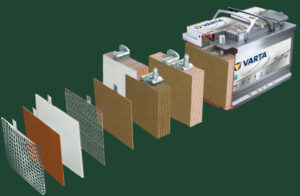
AGM stands for Absorbent Glass Mat. In these batteries the electrolyte is absorbed into a glass-fibre mat between the plates by capillary action. AGM batteries are more suitable for short-time delivery of high currents than gel batteries.
Discharging an AGM battery by more than 50 percent and up to 70 percent is not advisable if it is done frequently, this will significantly reduce the battery life cycle. If you discharge your battery to 30 percent, you will have about 1200 cycles. But, if you discharge the battery to 50 percent you will get around 550 cycles. In the worst case, if you fully discharge the battery to 100 percent, you will get about 320 cycles.
AGM batteries can withstand up to three times more cycle life than a conventional car starter battery and are best suited for vehicles with an automatic start-stop system. Conventional starter batteries are not built to handle the high-power demands of these systems so AGM batteries must be used.
Lead-Acid Battery Life Cycle: 250 to 1000 cycles

There are multiple types of lead-acid batteries, each with a different life cycle expectancy. Depending on how you maintain your battery and which type you have, you can expect to get somewhere between a few hundred and up to a thousand charge cycles.
Longevity in lead-acid very much depends on light discharges and proper recharge cycles. If a battery is going to be used for heavy power demands or deep discharges these batteries will get many fewer cycles.
Many manufacturers point to a similar figure of at least 1 000 charging cycles if used in proper conditions. However, extreme heat and other environmental factors can significantly reduce the life of a lead acid battery.
In addition, the increased maintenance requirements for lead acid batteries can also lead to shorter lifespans. It is not uncommon for personnel to have poor maintenance tracking procedures or not care for lead acid batteries in the manner recommended by the lead acid battery manufacturer.
Time Kills a Battery: Time and tide wait for no-one. And the same is the case with a battery. Whether you use it or not, the battery will deteriorate with time and eventually die. This is due to factors like increased internal resistance, loss of electrolyte, crystallization of electrodes, etc. The time effect was described by Arrhenius and is widely used by battery designers in estimating the life cycle of a battery. You need to remember that a battery will self-discharge itself even when idle.
Temperature Effects: Temperature affects both performance and life cycle of a battery (Battery and Temperature). Arrhenius Law also describes how a rise temperature speeds up the chemical reactions inside the battery. So whether you are using the battery or not, higher temperature means faster reactions and hence quicker discharge of the battery.
A rechargeable battery has a finite life cycle before it becomes unusable. You can extend this by proper maintenance, correct operating temperature, and regular but correct use.
How Can You Increase Battery Life?
Once you begin to understand how different factors impact your battery’s life cycle, it becomes clearer how you can increase your battery’s life. Following some simple “best practices” can help you get the most out of your battery, regardless of whether it’s a lead-acid or lithium-ion battery.
As much as possible, use your battery in moderate temperatures. Of course, this may not always be possible. It is optimal to store, charge, and discharge your battery in temperatures near 25 degrees C.
If you have a lead-acid battery, minimize how often you discharge the battery below 50% of its capacity. Ideally, the depth of discharge on each cycle should be between 10% and 50%. If you have a lithium battery, you can likely go down to 80% DOD and, in some cases, 100% DOD. Refer to your battery manufacturer’s recommendation to be safe.
Additionally, if you have a flooded lead-acid battery, make sure to keep the electrolyte solution topped off. Lastly, charging your battery slowly can help keep the internal resistance lower and extend your battery life as well.