
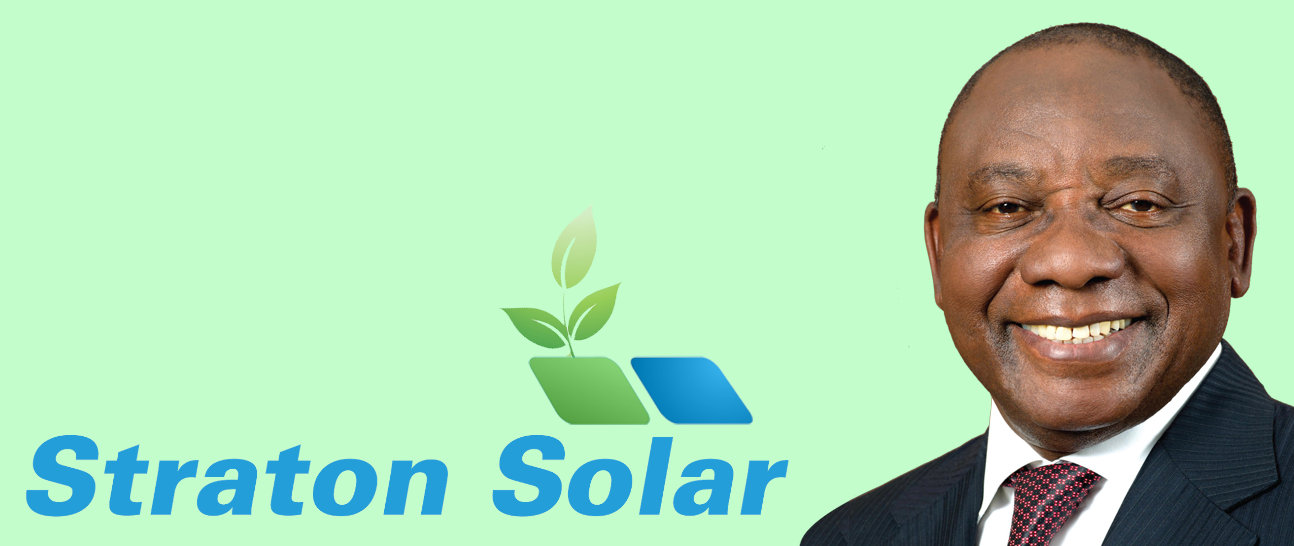
On Monday evening 25 June 2022, President Ramaphosa announced widespread plans to help get private investment onboard in solving South Africa’s energy crisis. “There is one major incentive that we would have appreciated the President introducing for domestic rooftop solar,” says Straton Solar (detailed in the last paragraphs).
The very last announcement in the President’s speech broadcast live to the nation concerned rooftop solar and he said that the government would enable and incentivise businesses and households to invest in rooftop solar by seeing that Eskom develops rules and a pricing structure — known as a “feed-in tariff” — for all commercial and residential installations on its network that would enable homeowners and businesses to sell surplus power to Eskom.
“The key words in this statement are; “on it’s network”. Our interpretation of that is that all clients that are on the Eskom network AND that receive a bill DIRECT from Eskom will be the ones to benefit first;” says Straton Solar.
We say so as Eskom has ‘agents’ – mostly in the form of municipalities – that resell electricity to residents, many of which have ‘feed-in tariffs’ already enabled.
The hope is that any form of feed-in tariff regime proposed by Eskom will be more logical, easier to understand, nationally applicable as a standard and, hopefully, more generous than any present tariff available.
Many municipalities have had a form of feed-in tariff available for many years. For example the Nelson Mandela Bay Municipality started it’s journey into renewables with a ‘one for one’ feed-in tariff that allowed owners of solar panels to offset any consumption with electricity generated and sent to the grid on a one for one basis, with no additional charges. The NMB now has a Time of Use Tariff for Solar Installations which offers better rates than customers without solar during ‘standard’ and ‘off-peak’ times with a much higher rate during the peak times of 7:00 to 10:00 am and 6:00 to 8:00 pm.
The City of Cape Town already employs a value for their feed-in tariff of 75.51 c per kWh. Small Scale Embedded Generators (roof top solar mainly) qualify for this incentive only if they consume more electricity than they generate in a 12 month period. Cape Town has a number of fixed monthly Service and Energy Charge tariffs depending upon the size of the installation and monthly use.
What President Ramaphosa failed to highlight in his speech is that Solar PV Systems must be registered, and for the following reasons:
- Registration is legally required in terms of many municipalities by-laws to ensure the safety of anyone who comes into contact with the PV system or the grid itself.
- Registration also makes sure that all those who are using electricity from the grid pay for their usage accordingly. Running your meter backwards or avoiding paying your share of the grid upkeep is illegal and puts greater strain on the rest of the city.
- An unauthorised PV system can: Increase the risk of fire and other hazards, Result in injury or death, especially if it is still feeding into the grid during a power outage. The property owner will be at risk of legal recourse under Occupational Health and Safety laws and c ause quality and sustainability problems with the electricity grid, specifically from unknown capacity and schedules of all generation on the network. This information is needed in order to maintain the balance of load and electricity quality.
- An unregistered system that causes fire or damage to a home or premises may also result in any insurance claims being refused.
AND that ‘one major incentive’ missed by President Ramaphosa?
Many countries around the world have some form of incentive for people installing renewable energy and buying Electric Vehicles – most of them as a form of Tax Credit on a sliding scale over a number of years. “Our suggestion is not in the form of a Tax Credit,” says Straton Solar.
Straton Solar Proposes the following incentive:
- A time based incentive to match the amount of time it takes to get Eskom up and running at full capacity
- Based on the number of kWh’s each consumer feeds back into the Grid allied with an electricity saving element
- This additional incentive will allow solar roof top producers to BANK excess power against their consumption for the duration of the amount of time in 1 above with a cap on the maximum allowed – e.g. 2 times current consumption
- This BANKED power to be used only after Eskom has returned to full capacity at the end of the incentive period.
In this way Embedded Generation producers will be able to over panel and feed back into the grid for simple reward based on investment and not on a tax credit.
The bottom line is still to make a decision to install rooftop solar based on readily available cash, the desire to use clean energy and on a ROI scenario that suits your pocket. And, it is that ROI scenario that elicited this comment; “Whenever we connect municipal power to a new installation the owner never asks what the ROI period will be, BUT, when we install a money saver such as Solar PV then the overriding concern is ROI,” concluded Straton Solar.