

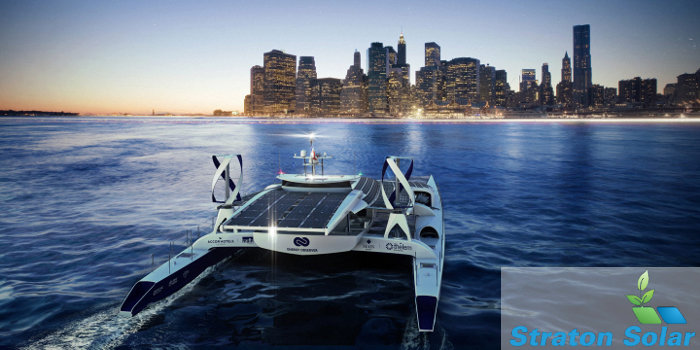
Energy Observer, a hydrogen vessel, will test and prove the efficiency of a full production chain that relies on the coupling of different renewable energies in an around the world voyage.
The former sailing boat has been re-purposed and clad in over 130 square metres of Solar Panels assisted by two wind turbines, a traction kite and reversible motors to provide clean renewable energy for power.
Energy Observer will be the “first hydrogen vessel around the world”. The boat will leave in the (Northern Hemisphere) Spring of 2017 for a world tour lasting 6 years that will start in Paris for the first of 101 stops in 50 countries.
Energy Observer will be the first vessel in the world capable of producing decarbonized hydrogen on board thanks to a renewable energy mix utilising wind and solar.
Leading the expedition will be Victorien Erussard, an offshore racer and merchant naval officer along with Jérôme Delafosse, a professional diver and producer of wildlife documentaries.
A team of over 30 people, architects, designers and engineers, spreading from Saint-Malo to Paris to Grenoble have been working since 2015 on refurbishing the catamaran.
Energy Observer is a former race boat that has been reconditioned: Built in Canada in 1983 by naval architect Nigel Irens, under the supervision of sailor Mike Birch, the maxi-multihull marked the evolution of its successors. Baptised Formule TAG, it was the first racing sailboat to break the symbolic 500 miles limit in 24 hours in 1984. The boat has since been lengthened four times and now displays the following dimensions: Length – 30.5 meters, Width – 12.80 meters, Weight – 28 metric tons and Speed – 8 to 10 knots.
Designed in partnership with a naval architect team and the CEA-LITEN (fr) of Grenoble, this experimental vessel is going to be the first with autonomous means of producing hydrogen on board and without emitting greenhouse gas emissions using renewable energies. The boat will produce and store hydrogen using seawater thanks to an energy mix involving: 3 types of solar panels spreading over a surface of 130 square meters, 2 vertical axis wind turbines, 1 traction kite and 2 reversible electric motors of hydrogenation.
Energy Observer will launch in winter 2017 for a series of tests at sea before its big departure from Saint-Malo in the spring. It will call in at Paris for a first event where the boat will be officially baptised. This event will celebrate the start of a six-year expedition, scheduled from 2017 to 2022, visiting 50 countries and 101 ports of call including: historical ports, wildlife sanctuaries, natural reserves, endangered ecosystems and international events. This expedition has for goal to reconcile ecology and technology and to prove that it is possible to reduce our impact on the environment without reducing our comfort.
Nicolas Hulot, President of the Foundation for Nature and Man and one of the the sponsors of the boat said; “We have the proof that we can reconcile ourselves with nature and that nature can be the best conveyor of the energy solutions of tomorrow.”

The schedule:
- 2017 – France
- 2018 – The Mediterranean
- 2019 – Northern Europe
- 2020 – Americas
- 2021 – Asia and Oceania
- 2022 – North East Africa and Middle East
The Energy Observer’s trip is expected to cost a minimum of €4m (around R57 998 261) a year.
Web Site: http://www.energy-observer.org
One other outstanding thing about Energy Observer is that she is being rebuilt and recycled for the purpose.
Energy Observer started life as Formula Tag and was built in Quebec in 1983 under the supervision of Canadian skipper Mike Birch in preparation for the Transat Québec-Saint-Malo. The work was coordinated by the Quebec architect Gilles Huot and it was the largest catamaran of the time at 80 feet. Formule TAG represented British yacht designer Nigel Irens’ first major design success in 1984 when this 80ft LOA catamaran set a new 24-hour run, clocking 518 miles.

Formule TAG then went on to come first in the Monaco to New York Race in 1985.
Under the name Enza New Zealand in 1994 she secured the Jules-Verne Trophy around the world in 74 days 22 hours 17 minutes and 22 seconds under the ownership of Robin Knox-Johnston and Peter Blake.
In 1997 under the name Royal & SunAlliance she set a new record for crossing of the Channel in 6 hours 49 minutes and 19 seconds. And, under the same name in 1998 set the Women’s record of crossing the North Atlantic in 9 days 11 hours 21 minutes and 55 seconds with British sailor Tracy Edwards’ all-female crew.
Two more name changes to Team Legato and Daedulus saw her set a South Atlantic crew record in 11 days 10 hours 22 minutes and 13 seconds during 2005.
In 2006, Tony Bullimore named her Doha and tried to break the circumnavigation record. He had to abandon his attempt after mechanical problems.
In 2009 she was renamed Spirit of Antigua.